
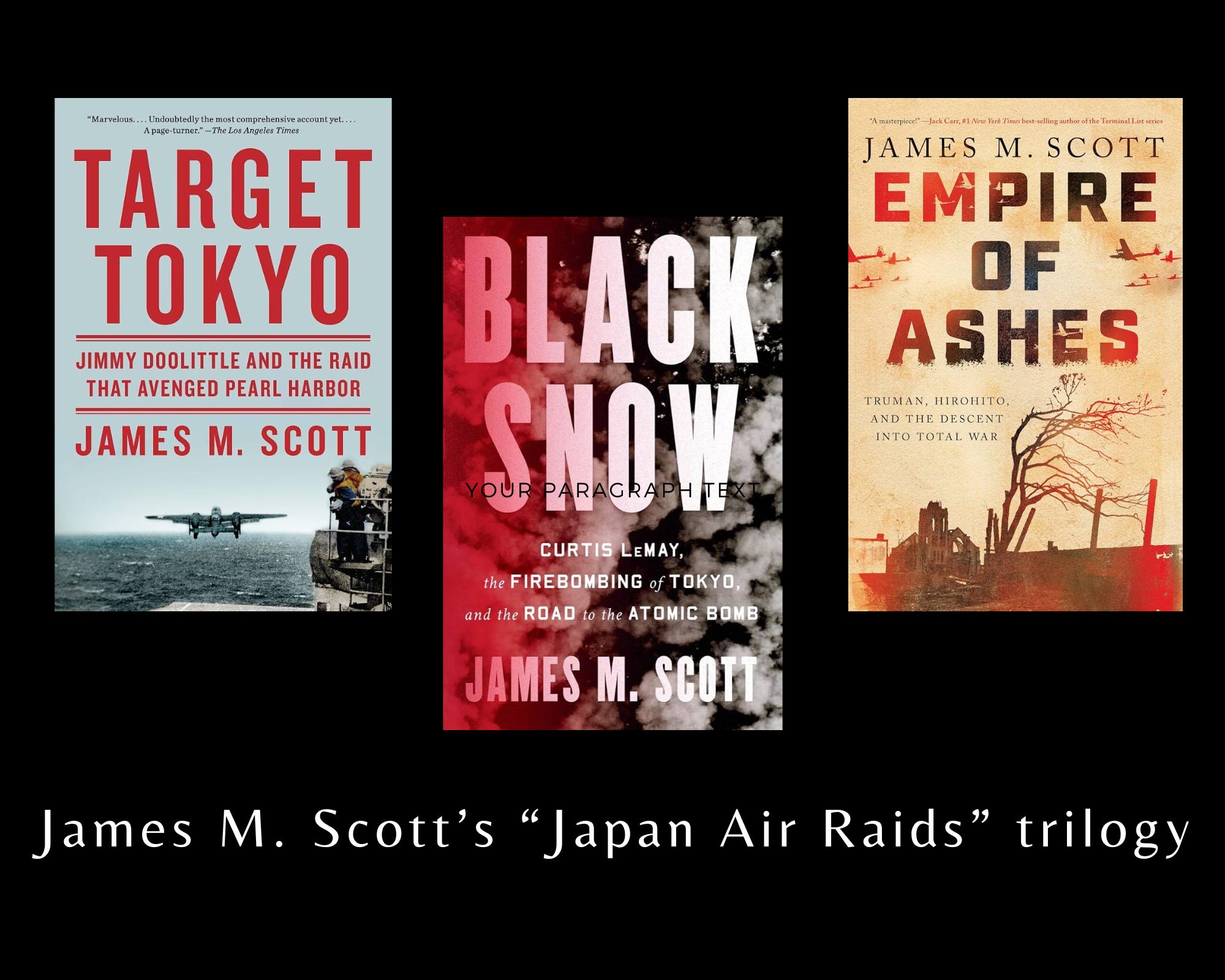
I’m a sucker for any book about Harry Truman, so when an early copy of James M. Scott’s Empire of Ashes landed on my doorstep — subtitled “Truman, Hirohito, and the Descent Into Total War” — I immediately moved it to the top of my reading list. I started in, but before I got too far I discovered that this was actually the third book that James Scott has written about America’s bombing raids in Japan. I put down Empire and grabbed Target Tokyo and Black Snow to read first. Little did I know, I had just kickstarted one of the best WWII reading experiences of my life and read all three in the span of a couple weeks.
Let’s explore a bit deeper.
And stay tuned in the next week or two for an interview with James M. Scott.
Target Tokyo — Jimmy Doolittle’s Famous Raid
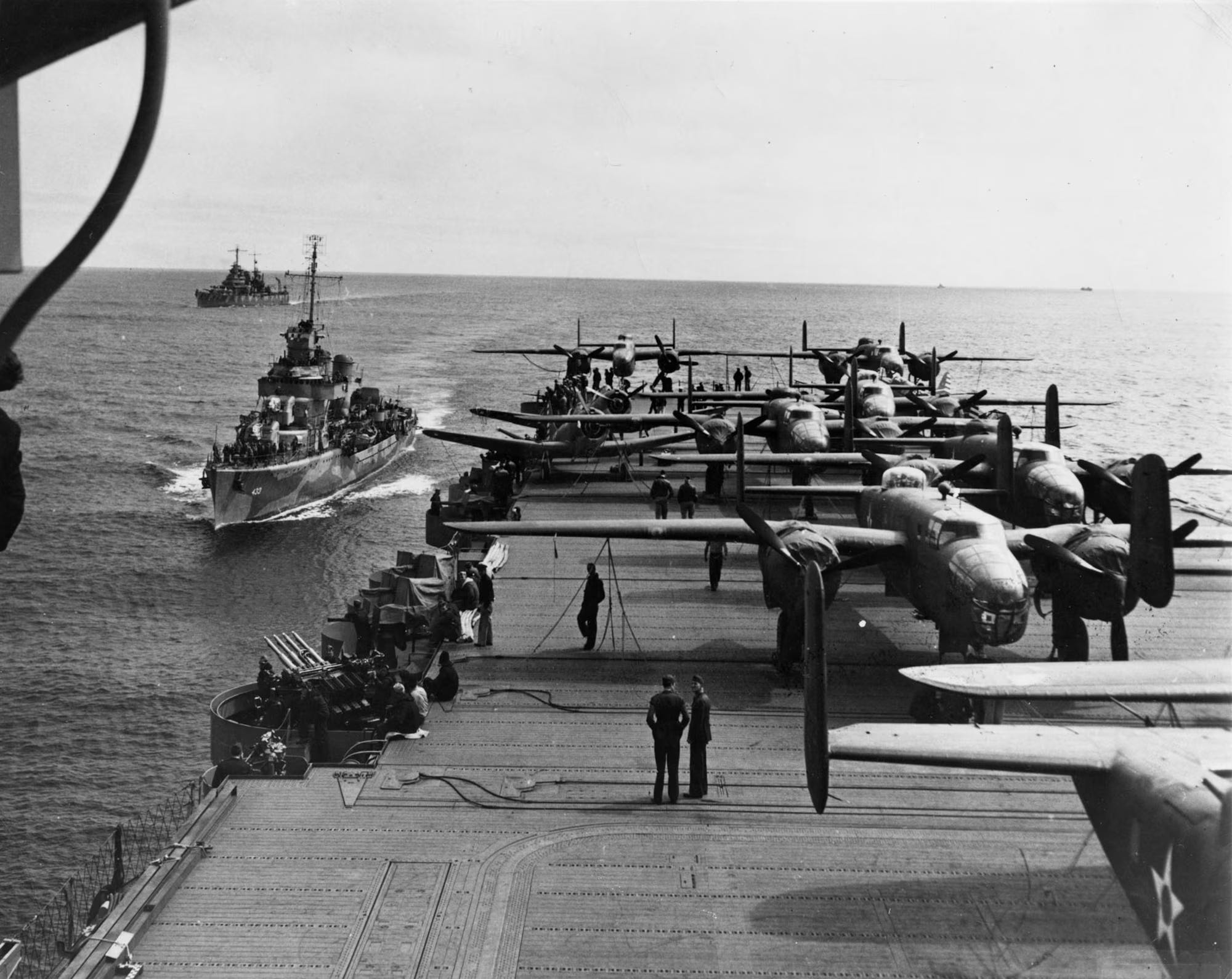
When you read enough WWII books and watch enough shows/movies, you inevitably stumble across Jimmy Doolittle’s post-Pearl Harbor bombing raid — it didn’t do a whole lot strategically, but made a big difference in morale for both the Americans and the Japanese. It also made Doolittle a hero both to the nation and to his own crew; as one crewman said afterwards, “He is the greatest guy that ever climbed in an airplane.”
In Target Tokyo, published in 2015, James M. Scott brings readers behind the scenes in those planning rooms, both on the American and Japanese sides. After Pearl Harbor, the U.S. needed to do something to respond, but our bombers couldn’t reach Japan at that point in the war, at least not without getting aircraft carriers too close to shore. So James Doolittle devised a plan that involved stripping B-25s (super cool planes, for aviation nerds) to their nuts and bolts, loading ‘em with bombs, and then continuing on to friendly Chinese airbases rather than returning home.
“The way both countries fought to control the narrative reflected the major effect the raid had for leaders in Japan and in America, a surprise given how truly insignificant the attack was compared with the raids that would dominate the war’s final months.”
But Scott’s narrative didn’t end after the raid; unbeknownst to me, there was still a lot more story left. All but one of the sixteen B-25s had to crash-land and the 80 men involved in the raid had to find their way back home; a few died on impact, many survived gruesome injuries before making it to safe harbors, and eight poor souls were captured by the Japanese and taken as prisoners. The aftermath for the injured and captured was harrowing, to say the least. It was hard to read at times, but I couldn’t put the story down.
Target Tokyo is a book that’s filled to the brim with individual acts of courage that are hard to fathom today. It’s probably my favorite of the trilogy. It’ll fill you right up with American vigor and patriotism — right in time for the next couple books to make you question your beliefs.
Black Snow — The Shift to Total War
While U.S. bombers couldn’t immediately strike Japan after Pearl Harbor (outside the Doolittle raid), military forces moved quickly to remedy that problem. By capturing a series of Pacific islands and spending billions to develop the massive B-29 (another very cool plane), General Curtis LeMay was set up to take the fight to the Japanese homeland in an all new way as the Pacific war came to a head in 1944 and 1945.
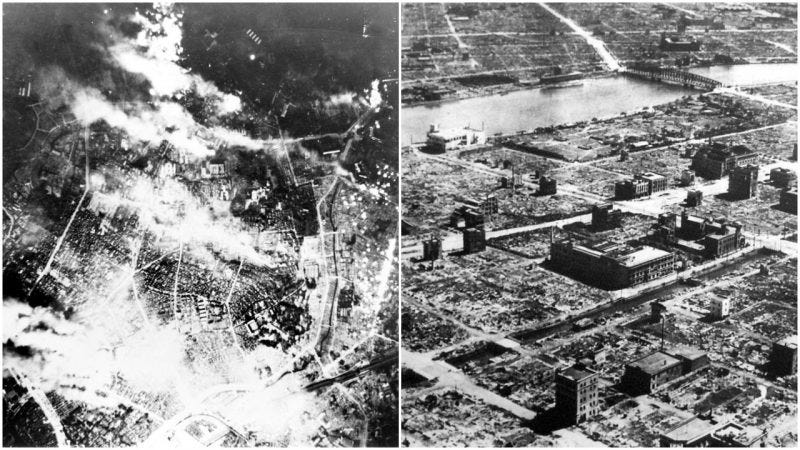
In Black Snow, published in 2022, Scott walks readers through the decisions that dramatically shifted America’s bombing tactics. Rather than utilizing daytime precision bombing of military targets — which wasn’t working — LeMay started nighttime raids of major urban areas. More than that, he began using materials like napalm, the flaming gasoline jelly that later became infamous in Vietnam.
The horror of these raids is hard to imagine. Japanese cities were dense and largely constructed of dry wood. They were tinderboxes. While we tend to think of the nuclear bombs as the moral shift of WWII, Operation Meetinghouse in the spring of 1945 — almost half a year before the nukes were dropped — killed as many people and destroyed as much square mileage. This was when America’s strategy changed to total war — no target would be off limits from here on out.
“The heart of this city is completely gutted by fire. It is the most devastating raid in the history of aerial warfare.” —General LeMay
In some especially grim but important chapters, James Scott brings readers to the ground level of Tokyo as these bombs are being dropped in the middle of the night, creating multiple literal and unstoppable firestorms across the city. It’s as harrowing as anything I’ve read.
Black Snow is a sobering read that’s likely to challenge what you think of the “good guys” vs. “bad guys” in WWII. The reality is closer to something like, “We all had to be bad guys in order to stop the really bad guys.”
Empire of Ashes — A Decision That Changed the Course of World History
While LeMay’s nightmare-inducing raids were destructive nearly beyond comprehension, they didn’t force Japan into surrendering. It was going to take even more.
FDR knew this and launched the Manhattan Project to develop the nuclear bomb — only he didn’t tell his vice president about it. So in the summer of 1945, when Truman had been president for just four-ish months, he had to guide the United States’ nuclear strategy with no template for what this bomb would do in the real world, and a real sense that whatever happened would permanently alter geopolitics from that point on.
There was not only a moral question, but a true strategic question, too. Would the bomb even work? What if it didn’t? Would it be enough? How many bombs would we have to use? How would Japanese leadership and citizenry respond?
“Truman took full responsibility for what would prove to be one of the most consequential decisions ever made by an American president and one that would forever define his legacy. His goal, he proclaimed, was to save lives.”
What James Scott does especially well in Empire of Ashes is take differing points of view — Japanese political and military leadership, American political and military leadership, and Manhattan Project leadership — and weave them together into an all-encompassing story. You can read about each of those threads separately, but this is the best book I’ve read that combines them into a cohesive narrative.
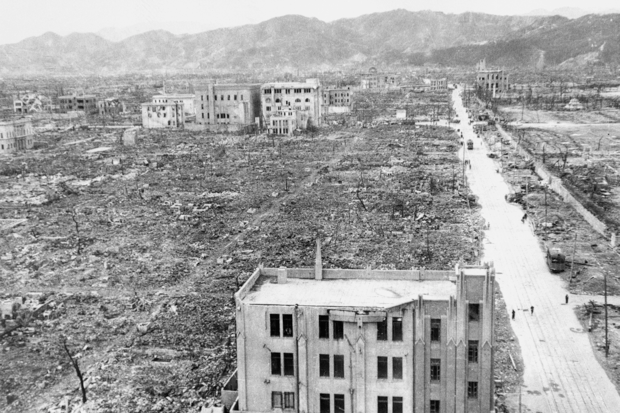
Scott also took the time to convey the horrifying on-the-ground experience of the events in Hiroshima and Nagasaki. It’s very well done and is certainly going to stay with me.
Empire of Ashes is an incredibly important book that deserves a place on any WWII shelf, especially when paired with the other two books in this unofficial trilogy.
Thanks for reading. Be good to each other.
-Jeremy
Going on my list also, thanks for the recommendation!
I will put these on my list as well. My knowledge of the war in the Pacific is limited to War and Remembrance and Unbroken. So much is devoted to the European theater of war. Thanks for the recommendations.