

Happy Friday, readers!
Later today, our family is headed down to Waterloo, Iowa to celebrate the launch of our dear friend Kayla Craig’s brand new book, Our Daily Breath. It’s fantastic and you should all buy it right now.
In today’s newsletter, I’m writing about a couple of Pulitzer Prize-winning non-fiction titles; they don’t make for lighthearted reading, but they’re written damn well and tell some particularly poignant stories about how corporate greed can and does literally cost lives.
As always, I’d love to hear what you’re reading and enjoying this week.
Toms River: A Story of Science and Salvation by Dan Fagin
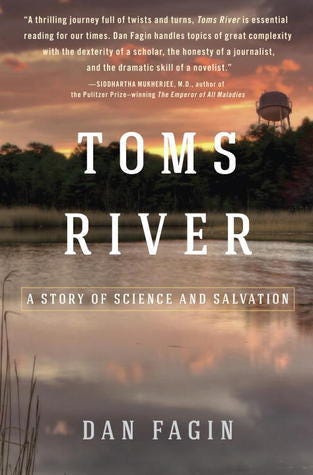
“A simple pecking order has always characterized mankind's relationship to waste: The wealthy throw out what they do not want, the poor scavenge what they can, and whatever remains is left to rot.”
Since chemicals were first manufactured thousands of years ago, there have been questions about contamination and waste. While toxic trash is not a new phenomenon, the science of what those byproducts do to our bodies is fairly modern. In Toms River, author Dan Fagin examines a cancer cluster in New Jersey that, over the course of decades, was proven to be linked to toxic waste in a complicated brew of willful neglect and terribly unlucky coincidences.
Turns out, it’s really hard to prove the causes of cancer, even when the answer appears obvious. In most cases, cancer comes about through second or even third order cell malfunctions rather than a direct line of A (bad toxin) —> B (cancer). This is why some folks can smoke their entire life without repercussions while many others cannot; it’s why some factory workers can experience deleterious health effects while others stay fine for decades.
Fagin brilliantly combines chemical science, cancer research, history, and human narrative into a page-turning package that I had a hard time putting down. It’s mostly infuriating, to be honest, but I learned more about science and medicine from this story than anything I’ve read in years.
Toms River is a book that I wouldn’t have encountered without my Pulitzer Project. I’m so glad I read it and I think you should too. It’s eye-opening from start to finish and you’ll never look the same way at headlines about cancer clusters or factory waste.
There Is No Place for Us: Working and Homeless in America by Brian Goldstone
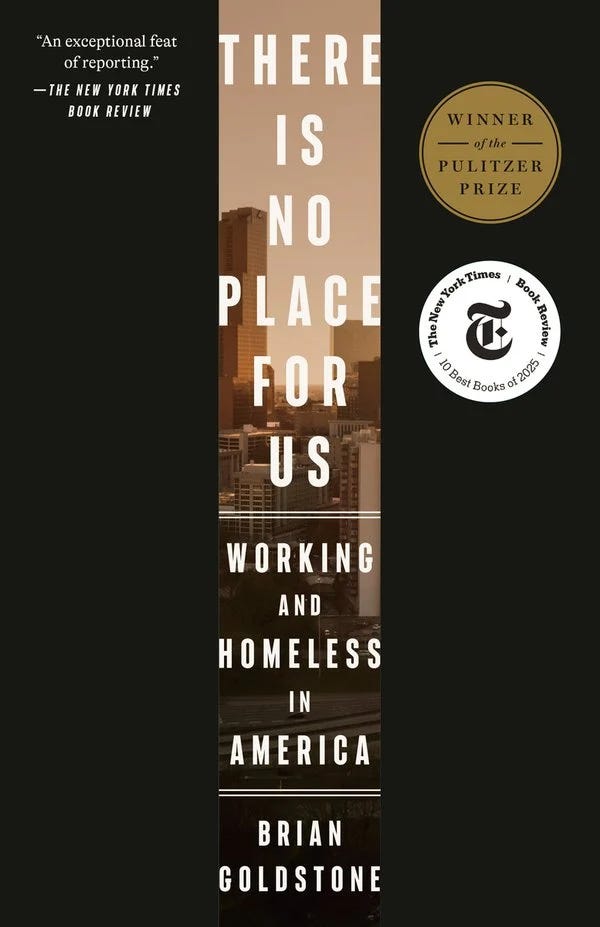
“What we’re seeing today is an emergency born less of poverty than prosperity. Families are not ‘falling’ into homelessness. They’re being pushed.”
There’s a pervasive conception of homelessness in America — one that I once had as well — that if folks could get a reliable job, they could eventually save up to get reliable housing. The real story is much more complex. As Brian Goldstone brilliantly details in this book, having a job does not automatically mean also having a home.
Goldstone follows five Atlanta families grappling with this problem. Over the course of months and even years, he shows that our conceptions of “the working poor” do not often match the reality. These are folks who are gainfully employed and working their tails off, but cannot find reasonable places to live. Many of them turn to extended-stay hotel chains, in which they end up paying more per month than they would on rent — if they could just get a lease. (You’ll learn a number of vile things about these chains.)
It’s a hard book to take in. There are no happy endings or tidy, wrapped up narratives. These people’s stories are still happening — and I’m sure some, if not all, are going poorly. It’s the terribly sad reality of how our country operates right now, especially in states with particularly restrictive housing and eviction laws. That said, it is also a moving portrait of resilience and hard work; it’s better for the world that these stories have been told.
There Is No Place for Us is a rather remarkable book that I’ve continued thinking about a couple months after finishing. If you combine this with Matthew Desmond’s Poverty and Evicted, as well as Barbara Ehrenreich’s Nickel and Dimed, you’ll come away with a dang good education in low wage work, homelessness, and poverty in this country.
Thanks so much for reading. Be good to each other. Until next week,
-Jeremy