
Happy Friday, readers!
This week I’m excited to share a couple of books that I read this summer which are now on bookshelves. My WWII reading has gone up a notch this year and these are a couple of my recent favorites. Authors A. J. Baime and William Hitchcock are not to be missed.
As always, I’d love to hear what you’re reading and enjoying.
Bird Men: The Rise of American Airpower and the Machine That Ended World War II by A. J. Baime
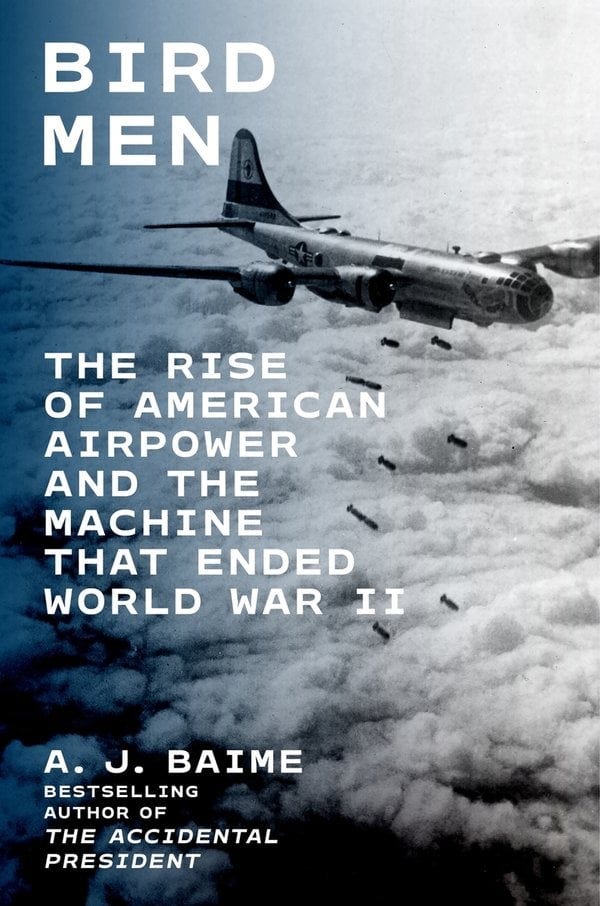
A. J. Baime’s The Accidental President — about Harry Truman’s incredibly consequential first handful of months in office — is one of the POTUS history books I recommend most often. As a historian, Baime knows how much detail to give, which anecdotes can illustrate a larger point, and how to keep a real-life narrative moving swiftly along.
So I was pretty excited when I saw he had a new book coming about one of my favorite niche topics: WWII aviation!
If that doesn’t appeal to you right off the bat, let me make the case a bit. In the 1930s and 1940s, military air power was still in its infancy — and America wasn’t very keen on building up its air force. (WWI left deep scars beyond just the physical.) But at the outbreak of WWII, Japan and Germany brilliantly used their air forces to attack allied nations in Europe, Asia, and eventually North America.
The U.S. had to catch up, and quickly. Enter Curtis Lemay — the commander who almost single-handedly created the Air Force as a military branch and identified that bombers rather than fighter planes would decide the war.
Baime absolutely found the compelling narrative behind all this and briskly told the story in under 300 pages. The political and logistical difficulties of creating new planes out of thin air — on ridiculously short timelines — was rather dramatic, as was the shifting of long-held military strategies. If you’re a WWII nerd, Bird Men is a great one to add to your list!
A Shadow Over the World: Franklin D. Roosevelt, the Rise of Fascism, and the Making of America's World War II by William Hitchcock
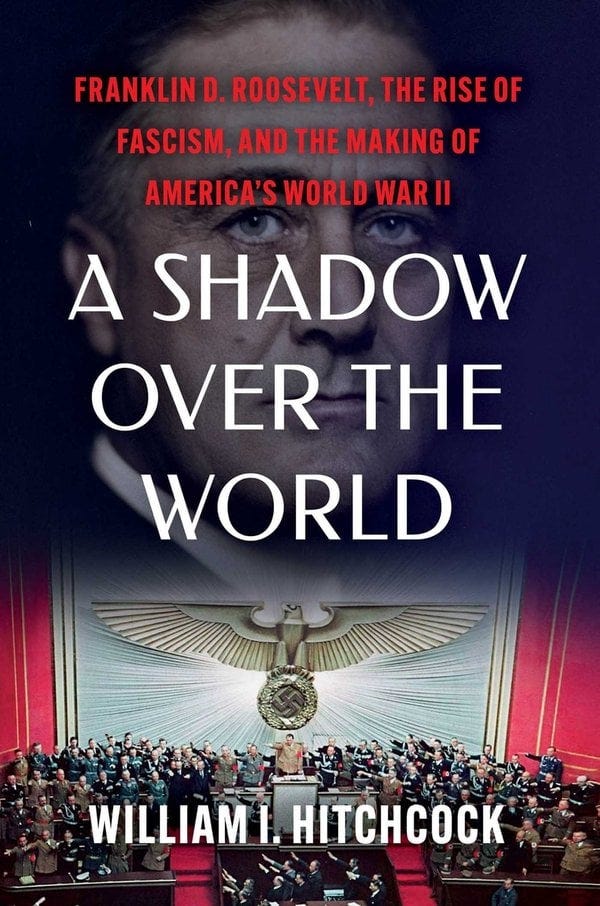
If you’re looking for an epic, globe-trotting tour of fascism’s rise and FDR’s (mostly) savvy political response, A Shadow Over the World is the book for you.
Covering all parts of the world and through a variety of POVs, Hitchcock shows how pervasive fascism was in the 1930s and how politically tricky it was to know how to deal with it (particularly before Pearl Harbor). The narrative can actually feel a bit jumpy, moving chapter by chapter from Italy and Mussolini, to Spain’s Civil War, to the Nanjing Massacre, etc. These things are covered in depth and allow you to understand the scope of the coming war, but it was a touch jarring before I got into the flow of the book.
Amidst all the context-setting, FDR looms on every page, biding his time and trying to get the backing of America’s popular will before taking action. He mostly comes off as cunning (in a good way) and heroic — perhaps even too much so, but it didn’t feel off balance.
One unexpected thread that I quite enjoyed was Hitchcock’s coverage of the media and journalistic takes on fascism and its charismatic leaders. Some reporters became enraptured by these leaders’ charm and masculine politics; others spent years sounding alarm bells, trying to get politicians to pay attention to what was happening behind the scenes.
While I quite enjoyed this book overall, it took me a while to get through. (No joke, I recently read The Brothers Karamazov in less time.) There’s no getting around the fact that A Shadow Over the World is thick and covers a lot of ground. That’s not necessarily a bad thing, you just have to know what you’re getting into before picking it up.
Thanks so much for reading. Be good to each other. Until next week,
-Jeremy