
“Why are we so good at accumulating information and power, but far less successful at acquiring wisdom?” —Yuval Noah Harari, Nexus
One of the things I try to do with almost every book I read is zoom out of the information on the page and dig a little deeper to figure out the bigger theme at play. I fight the impulse to merely accumulate information by reflecting on things like:
What big question is this trying to answer?
How does this particular story fit into the larger human story?
What does it have to say about human nature?
Is there wisdom to be found within these pages (rather than just info)?
Almost every book, even fluffy novels, can speak to one of these, especially if you go looking for it.
When reading becomes especially interesting (and fun) is when you start connecting seemingly disparate dots. While society has changed plenty in the last 10,000 years or so, human nature has, in many ways, remained shockingly consistent. It’s why ancient books like Homer’s epics, Marcus Aurelius’s Meditations, and religious texts can so profoundly speak to us today.
Most of the stories found in books — fiction and non-fiction alike — can be distilled into a few basic themes and ideas that are repeated over and over again: relationships, conflict, love, death, and how to live in a complicated world. If you reflect on these broader ideas, you’ll inevitably start to notice how books and authors from different genres and time periods can talk to each other. Literature nerds call this “the Great Conversation.”
At its core, this idea says that all work is built upon, and in conversation with, the work that has come before it. It’s perhaps an obvious idea, but one that’s utterly fascinating when found in your actual reading life.
This week, I was especially struck by the way that three very different books were talking to each other in my head. (This is also a benefit, I suppose, of reading more than one book at a time.)
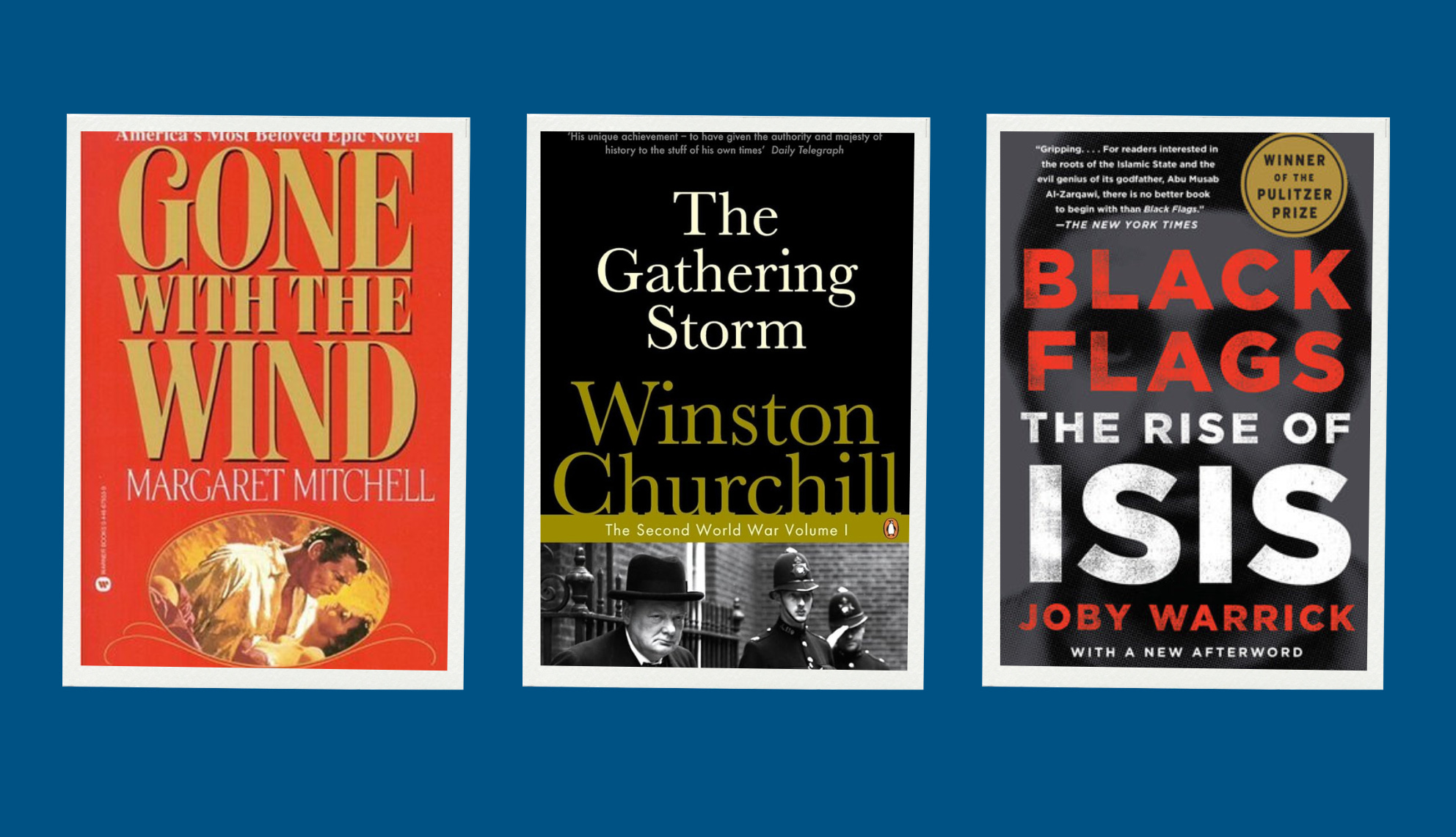
Gone With the Wind1, Margaret Mitchell’s 1936 epic about Civil War-era life in the Confederacy, is a Southern origin story. With both irony and unsettling earnestness, depending on where you’re at in the story, it depicts life in the South as a romantic, virtuous existence far more in tune with human flourishing than those damn Yankees.
Winston Churchill’s The Gathering Storm is volume one of his six-volume World War II memoirs. Amidst the rest of his resume, it’s easy to forget that Churchill won a Nobel Prize for Literature in 1953. The guy could write the hell out of a history or biography, deploying confident, stirring prose that simply leaves you in awe every once in a while.
Joby Warrick’s Black Flags2 is much newer than the previous two books. Published in 2015, it details the origins of ISIS — its founders, its conflict with Al-Qaeda, its relationship to the US’s ill-fated conflict in Iraq, its brutality for brutality’s sake, and much more. Unsurprisingly, there was much more to the unconscionable group’s story than what we saw in headlines and hot takes.
An epic romance, a political memoir, a terrorist origin story. The more I read and think about these three books — I’ve been reading bits of each most days — the more connected they’ve become. At their core, these books are about war and mythology: the Civil War and the mythology of the Lost Cause, World War II and the mythology of Good vs. Evil, the War on Terror and the mythology of religious utopia. And there are even more mythologies at play within each of these.
To distill even further, we could say that these are stories centered in belief and conflict: what we believe, how we’ve come to believe it, and how we respond when we encounter folks who believe different things.
These are ideas that are fundamental to the human experience. They always have been and they always will be.
When you take the time and energy to reflect on what you read, you’ll start to see that everything connects. Books and ideas talk to each other in a great conversation; that conversation can speak to us about what matters and how to live. Listen in!
-Jeremy
Winner of the 1937 Pulitzer Prize for Fiction
Winner of the 2016 Pulitzer Prize for General Non-Fiction
Excellent, thought provoking essay today. I love making connections between seemingly disparate works. That's for stretching my brain a bit this morning.
I love this. I've been trying for quite a while to put together some general questions I can keep in mind when reading any book and this is incredibly helpful. It might also be helpful for our book club discussions when we're not sure how to approach discussing a certain book. Thanks for all you do!