
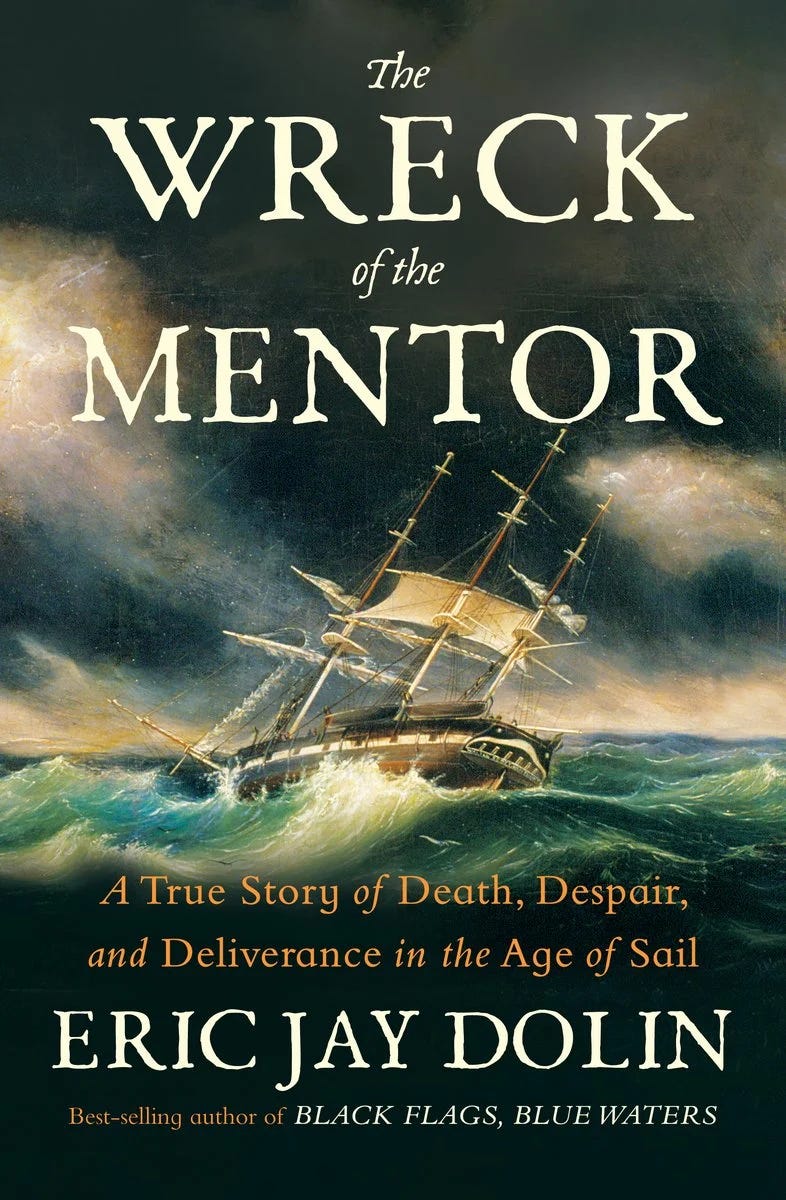
Published: 2026
Pages (not including notes/index): 206
No matter how many shipwreck books I read (Endurance, Into the Raging Sea, The Wager, In the Heart of the Sea, The Gales of November, The Perfect Storm . . . ), I can pretty much guarantee I’ll also want to read the next one that comes out. It’s a feeling shared by plenty of readers — especially guys. There’s something uniquely terrifying and thought-provoking about the idea of being in a survival scenario at sea rather than on land — if you can survive that, you've proven your mettle in a whole different way.
You might think that shipwreck stories start to blend together after a while, but they’re all genuinely unique in some way. I can tell you exactly what happened in those books I listed above — even if the circumstances are broadly similar, the ships, the people, and the aftermaths are different enough to be memorable.
What are your favorite shipwreck books? I’d love to hear!
A Wreck in the Remote Pacific

In Eric Jay Dolin’s new The Wreck of the Mentor, the shipwreck itself was really just the introduction to the larger narrative. The heart of the story is how this whaling crew encountered, adapted, and survived — or not — landing on a remote Pacific archipelago called Palau. (It’s best known for being the site of 1944’s Battle of Peleliu.)
In 1832, the American whaleship Mentor was in the midst of a multi-year, round-the-world voyage when it wrecked on a reef in the remote reaches of the ocean. They knew roughly where they were, and that contact with indigenous people was their only hope of survival. The problem was that those interactions were impossible to predict. Dolin did an excellent job showing how different groups of people responded to white men on their shores — sometimes they rolled out the red carpet and other times . . . they didn’t. In the case of the Mentor’s survivors (there were 11 at the time of the wreck), there were actually multiple groups of people to contend with at different times.
Over the course of multiple years, the crewmen tried to get back to America, wrecked again on another island, and even ended up in forced servitude. It won't surprise you that far fewer than those 11 men ultimately made it home.
Every time I read a well-done history book, I’m impressed by the complexity of human nature. No situation is predictable and those who survive are those who can adapt and respond when expectations have gone sideways. In any survival story, there’s a blend of luck, skill, and sheer endurance — if the luck has broken your way, a lot of it simply depends on human will, which is always fascinating to read about.
What Worked and What Didn’t
Dolin hits on a lot of different threads in just over 200 pages: the history of Palau, the background of whaling/whalers in this era, previous shipwrecks in the region, white men who survived those previous shipwrecks and lived for decades with the native people . . . at some points, it actually felt like Dolin was digging too much into the context rather than keeping the main story moving (especially since the book is on the short side).
The Wreck of the Mentor wasn’t my favorite book in this sub-genre that I love, but it’s absolutely worth a read if you enjoy shipwreck/survival stories — especially because it doesn’t require much of a time investment.
Further reading: Dolin’s history of whaling, Leviathan, is excellent; Fur, Fortune, and Empire, a history of America’s fur trade, is also high on my list.
Thanks so much for reading. Be good to each other.
-Jeremy
My recommendations: "In the Heart of the Sea," which is fabulous and terrifying. And in poetry, "The Rime of the Ancient Mariner" by Samuel Taylor Coleridge, especially with Gustave Doré's illustrations.
Read:
Ship of Gold in the Deep Blue Sea
by Gary Kinder