
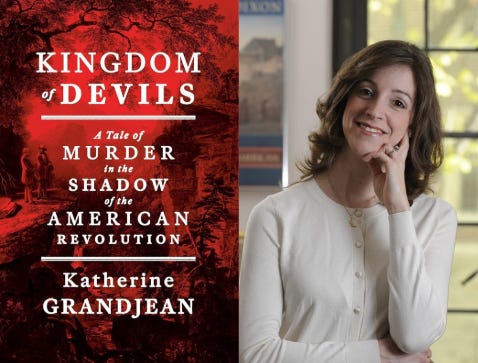
Katherine Grandjean is a historian of early America, particularly focusing on colonialism, violence, the environment, and the American Revolution. Her newest book, Kingdom of Devils: A Tale of Murder in the Shadow of the American Revolution, was published in June. It tells the fascinating (and incomplete) story of America’s first serial killers: the infamous Harp brothers.
If you missed my review, check it out now:

I was honored to be able to interview Katherine about her new book and why she finds the Revolutionary Era so appealing.
Read all my author interviews here.
And don’t forget to subscribe if you haven’t yet.
1. What piqued your interest in this time period and started you down the path as an historian of Early America?
I knew, very young, I wanted to be a writer. But it wasn’t until college that I really thought about writing history. As a kid, I wrote fiction and poetry. But when I was about nineteen, I ended up in a class on colonial American history, plunged into a strange world of county court records and midwives’ depositions and paternity lawsuits. There is something so intimate about reading historical documents sometimes; it’s as if you can hear what people were saying three hundred years ago. It’s like waking the dead.
Early America was particularly alluring to me because it is, on the one hand, very foreign. To study it is to travel to a wildly different world. And yet, it is also an origins story that explains much about how we live now. I like that paradox.
2. What about this crime in particular? How did you decide to tackle a case that you knew would lead to a lot of question marks and dead ends?
The question marks were part of the seduction, to be honest. One of the reasons I found the Harps’ story so irresistible was the mystery at the heart of it: Why did they commit all these murders? When I came across this case, several years ago, I had never heard of the Harps. But, like any historian, I immediately wanted to start diagnosing the causes, the things that went into the making of this episode. I found the impulse to try to solve the puzzle nearly unshakeable.
Dead ends are a regular part of historical research. There are always gaps in what can be known. The dead don’t always leave behind the kind of evidence we’d like. So that isn’t an unfamiliar feeling to me. And it’s doubly true, I think, when you’re investigating murder. Are there slam-dunk cases? Yes. But a lot of them are more cloudy and more circumstantial, and killers don’t usually give a fully satisfying explanation of their motives. So, particularly in a two hundred year-old case, I knew I wasn’t going to have the full picture.
But I still felt, early on, that there were new things to say about this story. And I felt that, where there were holes in the evidence, I could turn the lens outward to let the reader see more of the world around the Harps.
I mean, the honest truth is that I just couldn’t resist it, dead ends or not. The story just hooked me.
3. It was pretty easy to get away with violent crimes back then. Are modern forensics able to shed light on some of these things that went decades and centuries without being solved?
That is such an interesting thought! Probably not, in the Harps’ case. Hardly any physical evidence survives. Believe me, I had to comb through countless archives just to find the surviving documents that shine a light on their lives. But yes, in other cases, where bones and physical remnants persist, it is possible to read things in them that those in the eighteenth-century couldn’t have seen. Here’s a dark example of that: For years and years, historians debated whether or not there had been actual cannibalism at the Jamestown colony, as several records suggested. Then, more recently, archaeologists found a skeleton at the site which seemed to prove pretty convincingly that there was. So maybe we’re headed toward more of that kind of analysis.
4. How can this book and story speak to us today? Obviously, violent criminals and serial killers still exist. It seems, perhaps, that there’s something to be said for trying to dig into motivations and root causes rather than just writing crimes off as “bloodlust.” It’s rarely that simple.
Yes, it is rarely that simple. This is what people said, for generations, about the Harps: they were just bloodthirsty. Or they were monsters. But think about what happens when you call someone a “monster.” That’s the end of the story. That’s all you need to know. It actually forecloses on the possibility of understanding, in any deeper way, the person’s actions. Their motivations, their experiences, the societal pressures and the historical forces at play—all of that simply disappears from the conversation.
I think this story is profoundly relevant for modern Americans: It’s a tale about violent young men, taking out their rage on society. On innocent fellow citizens. Obviously, that is an affliction we’re still facing, even now. So maybe it’s helpful to try to understand some of its root causes…and its history.
5. Do you have any personal favorite Early America books?
Of course! So many. There are the classics: Edmund Morgan’s American Slavery, American Freedom, a sweeping saga of early Virginia, is just a model of narrative history. Laurel Ulrich’s A Midwife’s Tale—smart, beautifully written, a master class in how you can summon a whole world out of one woman’s diary. Gordon Wood’s The Radicalism of the American Revolution—he was a giant, and that book is the superstructure for a lot of my thinking about the Revolutionary era and its meanings.
Then there are some that really shifted my thinking: William Cronon’s Changes in the Land falls into that category. (It’s a classic study of how the environment changed as the English colonized the northeast.) Others I just have deep affection for, like Paul E. Johnson’s Sam Patch, the Famous Jumper, about a daredevil who became famous for jumping off of waterfalls in the early nineteenth century.
Is that enough shout-outs? I could go on…
6. Do you have a Mt. Rushmore of history books or authors?
This is a very hard question. Here’s the thing that jumps to mind: My favorite books aren’t histories, actually. The authors I most revere are more literary. F. Scott Fitzgerald. Herman Melville. Margaret Atwood. Twain. If you take some of their sensibilities, and mix in a little bit of Erik Larson or Michelle McNamara’s I’ll Be Gone in the Dark, you’ll get a sense of my influences.
Having grown up in upstate NY, which is proud of its Revolutionary War battlefields, I'm a history buff but never heard of the Harp brothers. Katherine's book sounds terrific!
Super interesting! Love her point about not just settling with “monster”. Also separates “them” from “us” - makes us blind to when other “monsters” show up if we just write off the last ones. Love these interviews Jeremy!