

Adam Cohen is a journalist, lawyer, and author of a handful of American history books, generally with a legal and ethical focus. He’s written about eBay, FDR, the Supreme Court, and most recently, a famed shipwreck.
If you missed my review of his excellent book, Captain’s Dinner, check it out now:

I was glad to be able to interview Adam about the book, shipwrecks, and some of his favorite history reads.
Read all my author interviews here.
And don’t forget to subscribe if you haven’t yet.

1. I’ve read a lot of shipwreck books, and plenty featuring cannibalism, but I haven’t read any that spent so much time on the (fascinating) philosophical and legal repercussions. Why do you think that dimension has been largely absent from historical disaster/tragedy books? If it’s covered at all, it’s often in a single chapter or epilogue.
In most shipwreck stories, people do what they want (or need) to do, and they are never held accountable. They kill people, they eat people — if they run out of food — and if they survive in the end, they simply return to their lives. The Mignonette shipwreck is different because when the survivors were rescued, they thought they would simply be allowed to go home — but instead, they were arrested and put on trial for murder, for killing the cabin boy and eating him.
Their murder trial became one of the great criminal cases in British legal history — and one that is also widely studied in America. So, this story of the killing and eating of Richard Parker, the cabin boy, is both an adventure story and a story about justice — about what is the fairest thing for society to do to the men who killed and ate him.
2. What surprised you the most about this story once you got into the research? Did you have any preconceptions that got thrown to the wayside?
I began with a strong sense that it was wrong for the captain the kill the cabin boy so that he and the other adults in the lifeboat should survive. I didn’t change that view, but it took on a lot more nuance for me when I read the grim details of what life was like in the lifeboat, and read up on the biology of thirst and starvation. The men’s mouths were so parched that they were making guttural, barking noises. They were so weak they could barely function. The more I read about what it actually felt like, the more I understood what the captain did — even if I still cannot approve of it.
3. Is the law around “the custom of the sea” still debated? Is it different from country to country, or do legal systems tend to agree on what’s right and wrong these days?
The truth is, this issue has largely faded away due to advances in technology. In the Age of Sail, the era in which my story occurred, shipwrecks were common. Being stranded without food or water was common. Cannibalism at sea was, if not common, not all that unusual. But 1884, the year the Mignonette was lost, was toward the very end of the Age of Sail. Steamships quickly replaced sailing ships. Ships soon had radio equipment to summon help.
So the “custom of the sea” was not needed. But the issue of whether killing one person to save several people remains a lively issue in philosophy and law school classes, and it is greatly debated there. The opinion of the Lord Chief Justice in this case has been very influential — it changed not only British law, but American law. I don’t want to say more, though, so as not to give away what happens.
4. Any recommendations for folks who want to further explore this niche subject area of law, ethics, and disaster?
A few things. There is a famous Harvard Law Review article from the 1949 called “The Case of the Spelucean Explorers” that reimagines the Mignonette case as the case of stranded cave explorers in the distant future, who kill and eat one of their fellow explorers, and are put on trial for murder. It offers five possible court rulings. It’s a classic inquiry into the moral issues of the case.
There’s also an essay called “Why Kill the Cabin Boy” from 2020 in which a British medical ethicist applies the lessons of the Mignonette case to the debate at the start of the Covid-19 pandemic about how to allocate ventilators when there are not enough to go around.
For people looking for something lighter, there is a much-loved episode of the TV show The Good Place on “The Trolley Problem,” which raises the same ethical issues.
In addition to my book, I wrote an article for Harvard Magazine called “The 1884 Cannibalism-at-Sea Case that Still Has Harvard Talking” that explores some of the key issues.
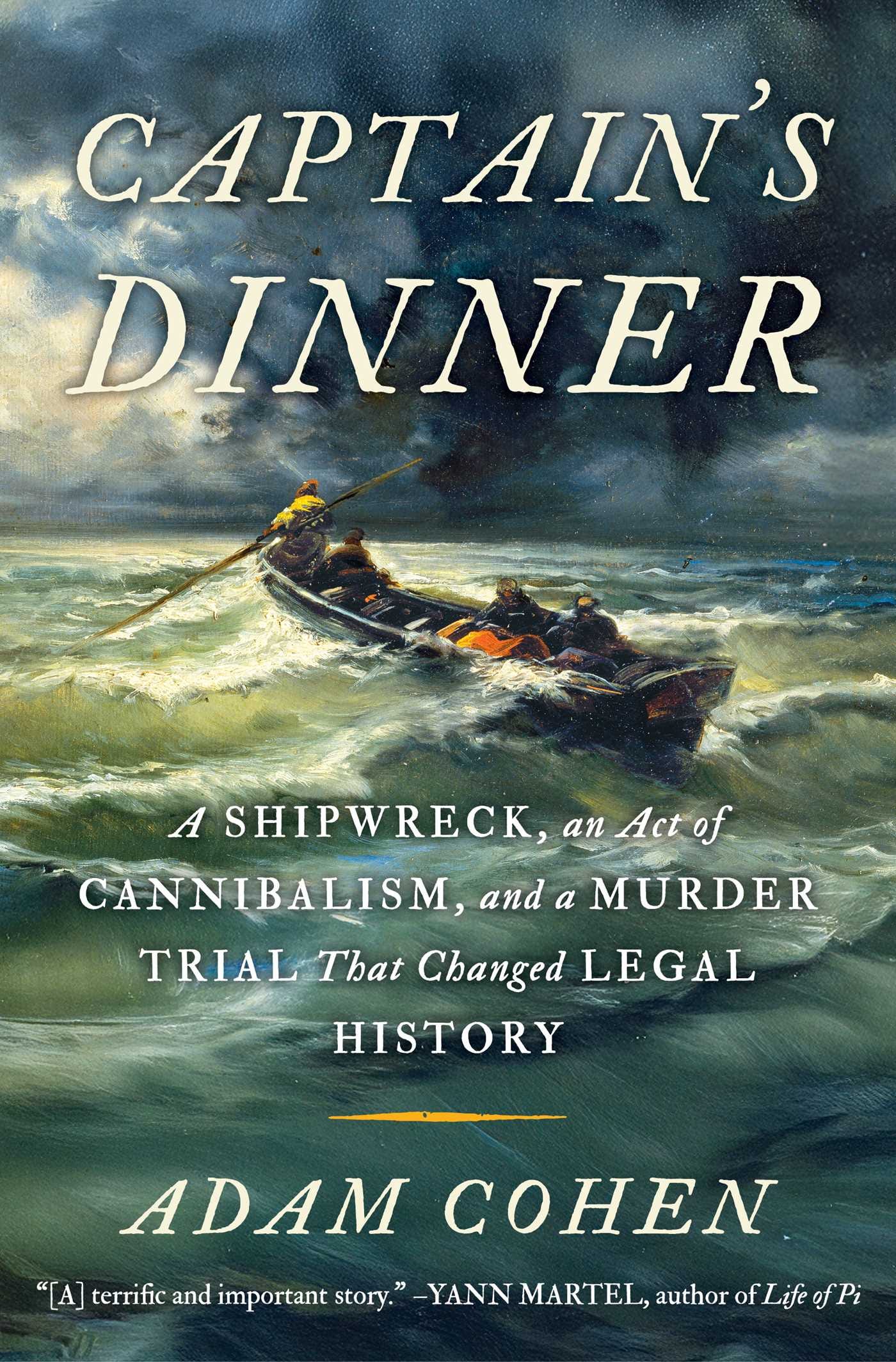
5. Legal writing is not exactly known for its page-turning qualities. How did you learn to spin such a readable yarn? Are there any particular authors or books that model what you try to do with your writing?
I actually think there has been so much great writing about the law and legal cases. When I was growing up, my parents had a classic two-volume collection by Ephraim London called The Law in Literature and The Law as Literature. One volume was particularly literary writing in the law — opinions, transcripts, and so forth. The other volume was legal subjects written about in great literature — short stories, excerpts from novels, and so on. It’s great, and I read it a lot as a child. I’ve also enjoyed many of the great books about the law — Harper Lee’s To Kill a Mockingbird, Truman Capote’s In Cold Blood, Richard Kluger’s Simple Justice — and so many more.
6. Beyond being just an interesting tale, how do think this story and subject matter can still speak to us? What does it have to say to modern readers?
The moral dilemma at the heart of the book is whether the captain was justified in killing one innocent person, the cabin boy, to save three other people, himself and the other two crew members. That issue is timeless. In philosophy, it is the debate between utilitarians and those who believe in rights-based theories of justice.
The utilitarians say a bad act can be justified if it avoids greater harm — kill the cabin boy to save three lives. The rights-based people say that some acts, like murder, as simply wrong — the cabin boy has a right to live, even if his death could save more lives. This question about utilitarianism is very alive today. If you read the essay I recommended about allocation of ventilators, you’ll see that it applied very directly in emergency rooms in England during the Covid pandemic.
7. Do you have any personal favorite shipwreck books?
There are so many great ones, including some recent ones, like Julian Sancton’s Neptune’s Fortune. But Robinson Crusoe will always be my favorite.
8. More broadly, what have you read and enjoyed lately?
It’s not a shipwreck story — except allegorically speaking — but I’ve been enjoying Maggie Haberman and Jonathan Swan’s book Regime Change about President Trump’s second term. I was also deeply affected by The Pope at War: The Secret History of Pius XII, Mussolini, and Hitler. I’m currently reading Stefan Zweig’s classic memoir The World of Yesterday, a great writer’s reflection on the world he loved, which was wiped away by the Nazis. I think I need to look around for some more cheerful subjects.
9. Do you have a Mt. Rushmore of history books or authors? (Or a few options, if you can’t nail down four.)
There are so many. I really like books that wrestle with America’s great promise, and the ways in which we fall short. One that is at the very top of my list is J. Antony Lukas’s Common Ground, which I regard as an almost perfect work of history. I am also a huge Studs Turkel fan, and I cannot recommend his majestic oral history Working highly enough. In a completely different vein, I keep finding myself going back to Ernest Hemingway’s A Moveable Feast. Pure pleasure. I’m listening to the audiobook (again) now.
Thanks so much for reading! Who would like to see next in my interview series? Let me know!
-Jeremy